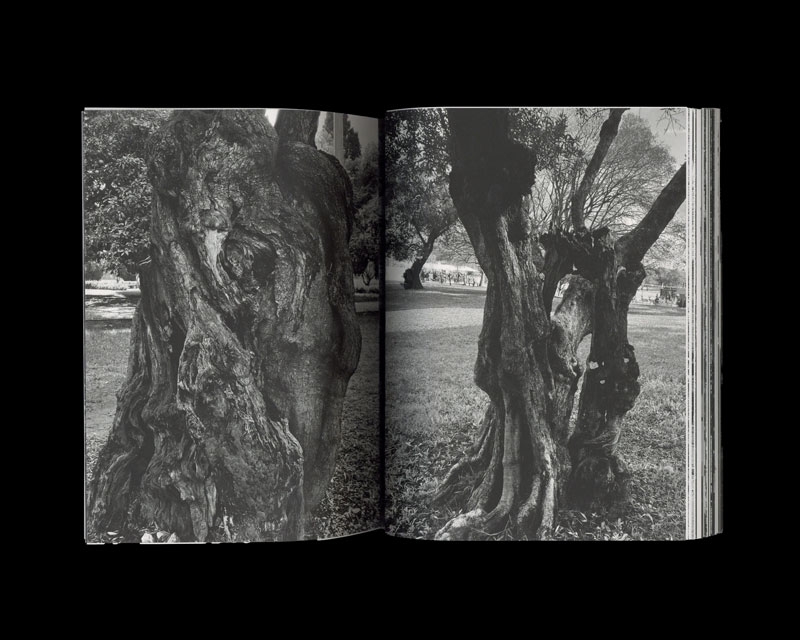
검정과 나무
이한범
작업을 처음 보는 순간 아무래도 가장 인상적으로 눈에 띄는 것은 검정색이에요. 이전의 작업들을 봐도, 재료나 기법은 바뀌었어도 검정색을 주되게 사용한 것은 일관되고요. 작업 노트를 보다 보니 검정에 관한 다양한 표현들이 있더라구요. 어둠이라든가 잉크의 검은색이라든가… 이것에 대해서 조금 생각하다 보니, 검정이 사실은 색채로서 쓰였다기 보다는 어쩌면 자신을 둘러싼 세계를 보고 다시 쓰는 방식 자체일 수 있겠다는 생각이 들었어요. 검정이란 건 작업에서 어떤 의미를 가지는가요?
노혜진
어두운 감정을 느끼고 부정적인 감정을 느낄 때면 제 안에 검정색 어두운 공간이 항상 보였어요. 그 공간에 알 수 없는 것들이 있다고 느꼈지만 아무것도 보이지 않더라고요. 제 작업은 불안에 대한 부정적인 감정에 대한 거고 그렇기에 검정색을 사용하는 건 당연하다고 생각했던 것 같은데, 지금의 제게 검정은 두려움이나 불안, 무서움의 감정보다는 조금 더 편안하고 안정적인 그런 공간이 되었어요. 저는 검정색을 공간이라고 표현을 하는 게 맞는 것 같은데, 그 공간에 대한 의미가 조금 바뀐 것 같아요. 제가 올해 초에 개인적인 어려움이 있었는데, 그때 저의 감정을 표출할 수 있는 공간이 제 방이었거든요. 밝은 곳에서 비춰지는 나의 모습, 그런 모습을 보고 싶지가 않았어요. 그 어두운 공간에서는 나조차 나를 못 보고 아무도 나를 못 보니 감정을 편하게 표출할 수 있었어요. 그러면서 그 검정이라는 공간, 검정색이라는 것 자체가 내게 안정감을 주는 그런 색, 공간으로 바뀌었다고 생각해요. 추천해주신 알랭 바디우의 『검정색』을 보고 나의 검정이 공간이구나 이런 생각을 하게 되기도 했고요.
이한범
이번 전시에서 선보인 작업에서는 검은 먹을 먹인 한지를 사용하셨어요. 색을 빨아들이는 종이의 특성 때문에 검은색은 광택 없이 아주 무거운 인상을 줍니다. 이전에는 실리콘을 쓰기도 했고, 나무를 태워 검은색을 만들기도 하고, 철가루를 쓰기도 하다가, 이번에 종이를 사용하게 된 계기가 있나요?
노혜진
작년에 본격적으로 작업을 시작했을 때 나무 재료를 중심으로 작업을 했어요. 아무래도 나무라는 게 어떻게 보면 검정이라는 그 공간과 저에게 비슷한 의미인 것 같거든요. 안정감을 주고 편안함을 주고 제 감정을 표출해낼 수 있는 그런 것. 돌이켜보면 나에게 어떤 재료가 어울리는지 뭐가 맞는지 그걸 찾는 시간이었던 것 같아요. 그 와중에 저는 나무가 아닌 다른 재료를 사용하면서도 나무의 질감을 내고 싶었어요.
이한범
나무의 질감이라는 게 어떤 건가요?
노혜진
거칠어 보이는데 그 안에는 정말 많은 시간들이 들어가 있는 것. 주름진 표면이 제게는 시간의 무게감으로 느껴졌어요. 그렇지만 또 어떻게 보면 따뜻해 보이는 그런 질감이요. 저는 그런 나무의 질감을 갖고 싶었고 그걸 진짜 나무가 아니라 다른 재료로 표현해보고 싶다는 생각을 했었어요. 제가 나무를 좋아하지만 저는 저 스스로를 나무라고 생각하지 않거든요. 그래서 철이나 실리콘, 철가루처럼 아예 상반된 재료들을 다뤄봤어요. 철은 직관적으로 차갑고 단단한 것이지만 또 어떻게 보면 주변 환경에 취약하거든요. 물이나 불이나 이런 것에 대해서 쉽게 변질될 수 있고. 저의 성향과 철이라는게 비슷한 점이 많은 것 같아요. 실리콘도 날씨나 이런저런 이유로 쉽게 변질되는 물질 중 하나거든요.
이한범
나무 얘기를 좀 더 해보면 좋겠어요. 『감정 일기』라는 직접 쓴 책자를 보면 나무들이 방대하게 기록되어 있어요. 숲의 풍경이라기보다는 형태적인 나무들. 그리고 나무들은 대개 생동하는 모습이라기보다는 바삭하고 메마르고 혹은 죽거나 버려져 있는 모습이고요.
노혜진
싱싱하고 풍성하고 단단한 나무들을 보면, 그것들이 나와는 반대의 느낌을 가지고 있으니까 말하자면 나를 긁는다고 해야 하나? 늘 그런 느낌이 살짝 들었어요. 반면 숲 속의 썩고 오래된 나무들을 보면 마음이 편해지더라고요. 비슷한 사람을 보면 조금 더 위로 받고 그런 것처럼요. 아니면 좀 더 많은 시간을 겪었을 할머니에게 위로 받는 느낌.
이한범
전시의 작업들은 구조를 가지고 있으면서도 어느정도 비정형적이었어요. 이는 직관적으로 생물학적인 어떤 차원을 상기시킵니다. 기하학적인 체계에서는 나올 수 없는 형태. 작업의 형태적인 측면이 나무에서 많이 참조된 게 아닌가 추측해봤습니다. 나무가 작가에게 미치는 영향이 좀 여러 방식인 것 같은데, 그 중에 하나가 미학적인 차원이겠죠. 그리고 나무를 다루는 일을 한다는 것에는 드로잉이라는 것이 중요해 보였어요. 전시장에 함께 놓였던 수많은 드로잉을 보다 보니, 그건 형태를 모사하면서 그 형태를 배우는 일에 가깝다는 생각이 들었거든요. 형태의 형성 과정이 궁금해요.
노혜진
제가 편안함을 느끼면서 보는 게 다양한 나무들의 형태다 보니 거기서 얻어지는 것들이 있어요. 그게 저는 또 되게 재밌고요. 더 재밌는 형태들도 찾는 것 같고. 학교 뒤에 작은 산이 있어요. 보통은 사람들이 무서워서 잘 안들어가는 공간이에요. 사람의 손이 거의 안 닿는 곳이니까. 그런데 저는 거기 가면 너무 재밌더라고요. 학교에서 사람들이랑 떠들고 그런 것보다 혼자 거기에 가면 안정감도 느껴지고, 재미도 있고. 그래서 작년에는 작업하다가 힘들어지거나 쉬고 싶어질 때면 계속 거기에 갔었어요. 거긴 제겐 정말 신세계에요. 그런 공간이 하나가 더 있는데, 제가 산책하는 안양천을 1시간 정도 걷다 보면 나오는 길인데 거기도 사람들이 들어가지 않는 곳이에요. 그 두 공간이 제가 가장 좋아하는 곳이죠. 둘 다 사람들이 다닐 것 같지 않고 되게 어둡다는 공통점이 있네요.
이한범
올해 초에 대만을 처음 가봤는데, 인상적이었던 것 중 하나가 타이베이라는 도시는 사실은 나무가 주인이고 사람들이 거기 얹혀 사는 느낌이 들었다는 거였어요. 어떤 장소에서 나무가 어떻게 존재하는지를 살펴 보면 그 공간 세계의 질서같은 것들을 어느 정도는 느낄 수 있게 되는 것 같아요. 그 깊은 숲이라는 건 어떤 질서인가 궁금해지기도 하네요. 저는 오래된 동화나 이야기를 좋아하는데, 많은 경우 인물이 숲으로 들어갔다 나오는 모티프를 가지고 있어요. 사람들이 사는 세계의 질서와는 완전히 다른 질서의 세계로 들어 가야 판타지가 가능한 서사적인 픽션이 생기니까요. 혜진 님에게 깊고 검은 숲은 무엇을 잃게 하고 무엇을 가능하게 하는 공간일까? 자연스레 그런 물음으로 이어질 것 같아요.
노혜진
얘기를 듣고 보니, 그곳은 색채가 없어지는 곳인 것 같아요. 풀의 초록과 하늘의 파랑과 사람들의 옷, 피부, 온갖 색으로 가득하다가 거기만 들어가면 모든게 무채색으로 보이거든요. 색을 뺀 채 무언가를 봤을 때 보다 더 온전히 볼 수 있다고 저는 생각해요. 색을 뺀 온전한 그 모습을 보고 싶어요. 색을 빼면 질감과 형태와 그런 것들이 조금 더 진실되게 보여질 것 같아요.
이한범
예전에 흰색 작업들도 좀 있었죠? .
노혜진
맞아요. 한두 개 정도 있어요. 당시에는 검정은 불안하고 두려운 부정적인 공간이고 흰색은 저에게는 이상적인 무언가였어요. 저는 모든 것들이 모여져서 검정의 공간이 된다고 생각했고 하얀색은 정말 아무것도 없는 무의 공간이라고 생각했어요. 그 무의 공간을 소유하고 싶다는 생각이 들어서 흰색을 사용했어요. 그런데 점점 저라는 사람과 흰색이 서로 맞지 않다는 생각이 들었어요. 저는 비어 있는 무의 세계와는 좀 반대인 사람 같아서. 저에게 흰색은 아마 영원히 무의 공간, 이상의 공간일 것 같아요.
이한범
감정에 관해서 계속 말씀하셨어요. 결국 검정이든 나무든, 저희가 얘기한 것들은 감정을 다루어내는 작업을 위한 것이겠죠. 그리고 작업을 관통하는 주된 감정은 아마 ‘공허(비어있음)’라는 것에서 비롯하는 것들인 것 같아요.
노혜진
제가 감정을 다루는 시작점을 공허함이라고 볼 수도 있을 것 같아요. 아무것도 없는 상태가 가장 어렵지만, 그런데 또 역설적으로 그런 시간을 원하기도 해요. 나는 아무것도 하지 않을 때, 하지만 그런데 세상은 여전히 돌아가고 있다는 것을 느낄 때. 나만 정지된 것만 같은, 어떤 공간에 홀로 남겨진 것 같은 느낌이요. 이런 상황에서 어떤 감정이 시작되는 것 같아요. 나의 존재 이유에 대한 고민, 혹은 세상에서 아무것도 아닌 존재가 된 것만 같은 생각들이 마음속에서 끊임없이 맴돌고, 제 마음 밖으로 나가지 못한 채 계속 부딪히고 있는 것만 같아요. 그러한 충돌에서 시작된 문제일 수도 있겠다는 생각이 드네요.
이한범
이 문제를 예술의 작업으로서 다루는 차원이라면, 이 문제가 어떻게 확장된 영역에 놓일 수 있을지 상상해보게 돼요. 감정은 개인적인 것이기도 하지만 동시에 사회적인 현상이기도 하고 특수한 경험이기도 하지만 동시에 모두가 통과하는 구조이기도 한 것처럼요. 작업은 여러 범주가 얽혀 있고 겹쳐 있는 그 지점으로 관객을 데려가야 비로소 문제적인 것이 된다고 생각해요. 감정이란 문제가 개인적인 것으로 수렴되지 않고 세계를 중층적으로 구조화 할 수 있는 계기로서 작동하게 되면 좋겠다는 생각이 들었어요. 그리고 그건 ‘감정’이라는 것을 비언어적 차원으로 더 잘게 쪼개서 살피고 이해하는 과정으로 추동되지 않을까 싶기도 하고요. 저는 조형이란 매우 특수한 탐색 과정을 통해 앎에 이르는 작업이라고 늘 생각을 해왔던 것 같아요. 그런 맥락에서 이번 전시를 보고 ‘검정’과 ‘나무’에 관해 얘기를 나눠보고 싶다고 생각했었습니다.
Hanbum
The moment I first encountered your work, the black color was the most striking. Even in your previous works, despite changes in materials or techniques, the consistent use of black stands out. Reading through your notes, I found various expressions about black—darkness, the black of ink, and so on. Reflecting on this, I started to think that black might not simply be used as color, but rather as a way of observing and rewriting the world around you. What does black mean to your work?
Hyejin
Whenever I felt dark or negative emotions, I always envisioned a dark, black space inside me. I sensed there were unknown things in that space, but I couldn’t see anything. My work has been about negative emotions such as anxiety, so using black felt natural. But for me now, black has become less about fear, anxiety, or dread and more of a comforting, stable space. I think describing black as a space feels accurate. The meaning of this space seems to have changed for me a bit. Earlier this year, I went through some personal struggles, and my room became the space where I could express my emotions freely. I didn’t want to see myself in bright light or let anyone else see me. In that dark space, even I couldn’t see myself, and neither could anyone else, so I could freely let out my feelings. Through this, black as a space—or as a color—transformed into something that gives me stability. Reading Alain Badiou’s Black: The Brilliance of a Non-Color also helped me realize that my black is a kind of space.
Hanbum
In the works you presented in this exhibition, you used black Hanji paper soaked in ink. The paper absorbs the color, giving black a heavy and matte appearance. Previously, you used silicone, burned wood to create black, and even worked with iron powder. What led you to use paper this time?
Hyejin
When I first began working in earnest last year, my focus was on wood. In a way, wood carries a meaning similar to black spaces for me. It provides stability, comfort, and a means to express my emotions. Looking back, I think that time was about exploring which materials suited me best. While using materials other than wood, I found myself wanting to replicate the texture of wood.
Hanbum
Can you explain ‘texture’ in more detail?
Hyejin
It looks rough but holds a sense of time within it. To me, the wrinkled surface of wood feels like the weight of time. At the same time, it can also appear warm and inviting. I wanted to capture the texture of wood, but not with actual wood—I wanted to express it using different materials. While I like wood, I don’t see myself as wood. That’s why I’ve explored contrasting materials like iron, silicone, and iron powder. Iron, for instance, is intuitively cold and hard, but it’s also vulnerable to its surroundings, like water or fire, which can easily alter it. I think my personality shares similarities with iron. Silicone, too, is a material that’s easily affected by weather and other factors.
Hanbum
Let’s talk more about wood. In your self-published book Emotion Diary, there are extensive records of trees—not so much landscapes of forests, but individual, form-focused trees. Most of these trees appear brittle, dry, or dead rather than lively.
Hyejin
When I see vibrant, robust trees, they feel opposite to me—almost as if they’re scratching at my spirit. I always slightly felt like that. On the other hand, when I see old, decayed trees in the forest, I feel at ease. It’s like finding comfort in meeting someone similar to yourself—or like being comforted by a grandma figure who has experienced more time.
Hanbum
The works in this exhibition possess a sense of structure while also being somewhat amorphous. They intuitively evoke a biological dimension—forms that couldn’t emerge from geometric systems. I suspect the shapes in your work draw a lot of inspiration from trees. It seems trees influence you in multiple ways, including aesthetically. Observing the numerous drawings displayed in the exhibition, I felt they were less about imitation and more about learning forms. I’m curious about the process of shaping these forms.
Hyejin
I find comfort in observing the diverse forms of trees, and they also inspire me. Exploring more interesting shapes is something I genuinely enjoy. There’s a small hill behind my school—a place people avoid because they find it weird. Since it’s largely untouched by humans, I find it fascinating. It feels much more grounding and enjoyable than chatting with friends at school. Last year, whenever I felt overwhelmed or needed a break, I’d always go there. It’s like a whole new world for me. There’s another space I like—it’s a path I often walk along by Anyangcheon stream. After about an hour, it leads to a place where no one else goes. These two spaces are my favorites, and both share the common trait of being dark and unfrequented.
Hanbum
When I first visited Taiwan earlier this year, one of the things that struck me about Taipei was how trees seemed to dominate the city, with people merely coexisting around them. Observing how trees exist in a particular place can reveal something about that space’s order. Deep forests, for instance, make me wonder about their unique order. I love old fairy tales, many of which feature a character entering and leaving forests—a world of completely different order, essential for the emergence of fantasy narratives. What does a deep, dark forest mean to you? What does it take away from you, and what does it make possible?
Hyejin
Now that I think about it, it feels like that place is where colors disappear. The green of leaves, the blue of the sky, the colors of people’s clothes and skin—all vanish in there, turning everything into shades of gray. I believe that by removing color, you can see things more purely. Without color, textures and forms reveal themselves more truthfully.
Hanbum
You’ve also worked with white in the previous works.
Hyejin
Yes, just a few. Back then, black represented an anxious, fearful, and negative space, while white was an ideal for me. I thought black was a space filled with everything, while white was an empty void. I wanted to possess that void, which is why I used white. But over time, I began to feel that white didn’t suit me. I think I’m fundamentally opposed to the idea of a vacant, empty world. For me, white will always remain a space of nothingness—an ideal world.
Hanbum
You’ve frequently mentioned emotions. It seems that, whether it’s black or wood, your work ultimately explores how you approach emotions. The primary emotion running through your work might stem from “emptiness.”
Hyejin
I agree with you saying my starting point for dealing with emotions is emptiness. That state of having nothing is the hardest, but paradoxically, I find myself yearning for such times. When I do nothing, but the world keeps moving—that sense of being the only one left behind in a halted space. It’s like being left alone in a void. I think emotions begin to arise in such situations. Thoughts about my reason for being or feelings of insignificance—those thoughts seem to endlessly cycle inside me, unable to escape, constantly clashing. My work might be rooted in resolving these internal conflicts.
Hanbum
In approaching this issue as an artistic practice, I find myself imagining how this problem could be situated within a broader context. Emotions are deeply personal yet also social phenomena; they are unique experiences but also structures that everyone passes through. I believe an art work becomes truly significant when it takes the audience to that intersection where multiple categories intertwine and overlap. I hope that the issue of emotions doesn’t simply converge into something personal but instead functions as a catalyst to structure the world in more layered and complex ways. This might involve breaking down and examining the non-verbal dimensions of “emotion” in finer detail to better understand them. I’ve always thought of artistic practice as a highly specialized exploratory process that leads to a form of knowing. In that context, after seeing this exhibition, I felt compelled to discuss “black” and “wood.”